What Made Someone A Communist?
Obviously, there is a simple answer: they believe in a communist ideology. However, this project is not particularly focussed on the exact political alignment of its interviewees. The difference between a Trotskyite, anti-revisionist, and Eurocommunist is certainly interesting, and each group would no doubt have a lot to say on the others.
Nevertheless, a key purpose of this project is to discover what it is about individuals’ inner and outer lives that attracts them to communism, and how those individuals reflect on the outcome of the movements as a whole. This article will present three aspects that come together to help answer the title question. This answer is based on a series of anecdotes, so is certainly not accurate for the totality of communists, but it may explain why some did in the 1980s and 90s.
Aspect One: Internationalism
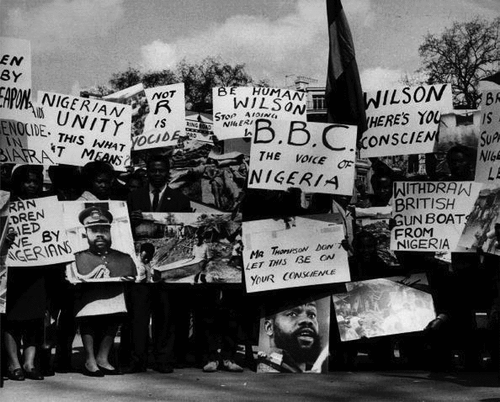
Throughout the interviews in the British Left Oral History Project, there is one question I ask before any other: “What was your first introduction to politics?” This question doesn’t only come first because it makes sense to start at the beginning, but it usually brings to people’s minds the single spark that led them down the path that, inevitably in this project, ends with communism. In the mid-20th Century, when most of my narrators were children, the UK was a nation on the cusp of conservatism and social democracy, of imperial dominance and post-colonialism, a dynamic time to develop a political philosophy of ones own.
What I have found is quite interesting. The majority of people interviewed, so far, had a distinctly internationalist answer to my question. One interviewee was incensed at the Biafran War, and Britain's role in the humanitarian crisis there. Another read Red Star Over China, which changed her understanding of the Chinese people. Stuart Hill explains below how his sympathy for the Vietnamese drew out his political consciousness.
Stuart Hill on Vietnam:
The fact that so many people seem to be drawn to international causes as children or adolescents is interesting. Perhaps the children did not yet grasp the general concept that most adults subscribe to, that events in ones own country take precedence over events in others, even if they are far more dire elsewhere. Especially in a Cold War setting, where all of my interviewees grew up, this empathy for the other would inherently drive people away from the mainstream.
Others, when exposed to a far greater variety of cultures and perspectives as older teenagers or students, may have found that the prejudices ideas that dominated their youth did not ring true, as is the case with Ella Rule.
Ella Rule on Prejudice:
Aspect Two: Community
Another important reason why some were attracted to communism, and certainly why they stayed in particular groups within the Left, was the sense of community they found there. It is one thing to hold communist or socialist-adjacent beliefs, implicit or recognised, but it is another to dedicate a significant amount of your life to a cause. The existence of communities in leftist groups helped with that a lot. Steve Nally talked about how being part of Militant helped bring people together.
Steve Nally on the Militant community:

Probably everyone reading this understands the feeling that you get when you come across a group of likeminded people. Suddenly, your interests which might have seemed alien to most of the people in your life, are justified by the immediate presence of people you can talk to in good faith. For many people, this discovery of community may be based on interests, hobbies, religion (or lack thereof), but the people I’ve been talking to in this project found their community through shared politics.
There was undoubtedly people in the 80s and 90s who self-identified as communists, socialists, or leftists, possibly voted for them and read their press, yet never made the transition into officially joining a group – yet they could still be part of the wide community of the Left. Andy Croft explains below how the Left fused politics and community-building.
Andy Croft on Community:
Aspect Three: Fighting Back
This is probably the answer that the vast majority of communists, socialists, and most -ists, would give you. For many of the interviewees, there was a feeling that the current state of the world, and more specifically Britain, was not good enough. For Neil Kinnock, who spent a lot of his time as leader of the Labour Party fighting against the Militant Tendency, this was a case of frustrated youths being led down an incorrect path.
Neil Kinnock on youth frustration:

The members of such groups, of course, would not have subscribed to this outlook, at least not in the words that Neil used. Instead, most argue that their ideology provides an answer to the problems of the time. Because their ideologies remained on the fringe in Britain, they therefor had to join organisations outside of the mainstream.
This opposition to the current state of the country was only intensified as the Thatcher government implemented their policies, which were seen as an attack on working class people domestically, and on global communism internationally. For many, the perception was that mainstream politics was not doing nearly enough to fight back against Thatcher; the term "Thatcherism" was invented to explain the total hold her wing of the Conserviative Party had on the UK during her reign. This term was popularised in Marxism Today, a major left-wing magazine. This goes some way to explain why the left was appealing; it was able to articulate the frustrations of the masses into a distinct ideology. Steve Nally explains his frustration at the time.
Steve Nally on youth frustration:
These are just three reasons, among many, that people dedicated part of their lives to left-wing politics. People also spoke about the culture of the Left, be it poetry or Rock Against Racism, they spoke about their frustration with centre-left institutions that failed to meet their radicalism. It is also a snapshot of the second half of the last century, a time of socialist decline, both in Britain and globally. No wonder socialist people were finding solace in breaking away from the political norm, whether it be by supporting their global comrades, finding likeminded people, and fighting agains the system however they could. In the end, oral history is about getting slivers of the big picture from small stories which, I hope, this project has helped you appreciate.